


The real cost of a group trip isn’t the flights and hotels. It’s the four-day silence after you get home — when the trip WhatsApp group has gone suspiciously quiet, and everyone is privately running numbers in their head but nobody wants to be the first to bring up money.
One person fronted the Airbnb deposit. Someone else covered the rental car. Three people said they’d “get the next round” more times than anyone actually tracked. And now, a week after the best trip of the year, the most common group chat message is seen by everyone and replied to by nobody.
This guide is about how to split travel expenses properly — so the money conversation happens before the trip, during the trip, and cleanly after — and never becomes the thing people remember more than the trip itself.
The Real Cost of a Group Trip (It’s Not the Hotel)
Here is how to split expenses on a group trip fairly: agree on a tracking system before the first payment is made, log every shared expense in real time as it happens, and settle all balances at the end of the trip in one go — not mid-trip, not from memory, and not via a WhatsApp thread nobody can search.
That’s the short answer. The rest of this guide is the practical how-to.
Why Group Expenses Always Get Messy

There’s no malice in group trip money chaos. There’s just a predictable failure pattern — and once you’ve seen it, you can’t unsee it.
Stage 1: The informal understanding. Everyone agrees to “keep it roughly equal” and “sort it out at the end.” Nobody defines what “roughly” means. Nobody writes anything down.
Stage 2: The informal tracking. One person starts noting costs in their Notes app. Another keeps mental tallies. A third has completely forgotten they paid for the boat trip. The spreadsheet someone opened in Week 1 was edited twice and is now three versions behind.
Stage 3: The post-trip confusion. Someone sends a message with a total. Someone else disputes a number. A third person points out they paid for something that wasn’t included. Everyone is slightly wrong and slightly right simultaneously. The numbers never fully reconcile.
This happens on trips between close friends who genuinely trust each other. It’s not a trust problem. It’s a system problem.
Step 1 — Have the Money Conversation Before You Book
Before any hotel is booked or any flight is searched, ask every group member three direct questions. The answers will tell you exactly how to structure the trip financially — and prevent every awkward conversation that would otherwise happen at the end.
The Three Questions Every Group Should Answer Before Booking
Question 1: What’s your comfortable daily spend per person (not your maximum)?
There’s a difference between what someone can afford and what they’re comfortable spending on a trip. Get the comfortable number. If you plan around the maximum, someone will spend the whole trip quietly anxious about money. If you plan around the comfortable number, everyone enjoys the trip.
Question 2: What counts as a shared cost versus a personal cost?
Accommodation, shared transport, and group dinners are obviously shared. But what about the person who drinks and the person who doesn’t? The person who does the water sports and the person who reads on the beach? Define the boundary early. Shared = everything the group does together. Personal = anything individual. This removes 90% of post-trip disputes.
Question 3: Who handles bookings, and how are they reimbursed?
If one person is booking the Airbnb on their card, they’re extending credit to the group. Make this explicit — not assumed. Set a payment deadline. Tell the group what the amount is and when it needs to be transferred. “I’ll book it and sort it out later” is how someone ends up 40,000 rupees out of pocket waiting to be reimbursed two weeks after the trip.
Step 2 — Start Tracking From the First Payment — Not the Last
Start logging expenses from the first shared cost — even before the trip begins. Pre-trip expenses like accommodation deposits, activity bookings, and group transport are easily forgotten by the time you’re sitting at the post-trip settlement.
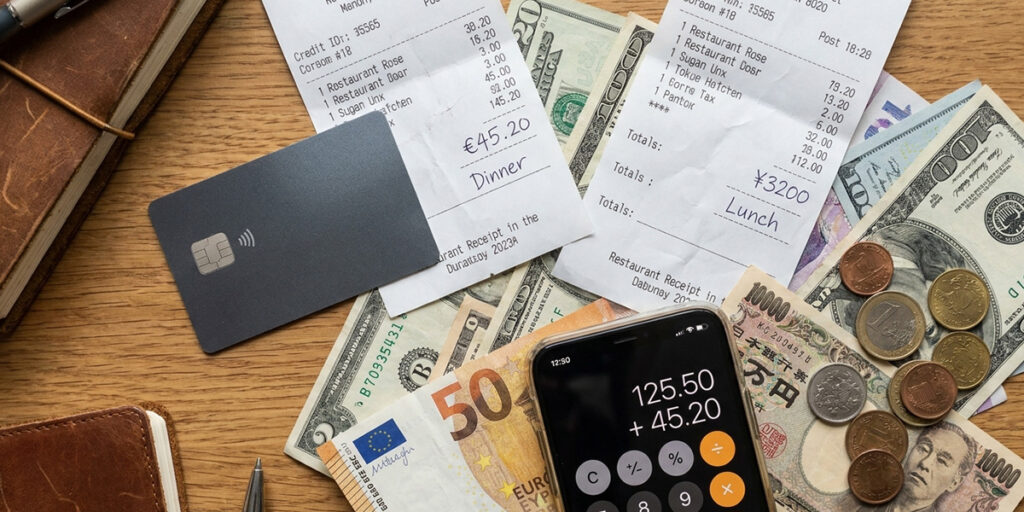
Most groups make the mistake of thinking expense tracking starts when the trip starts. It doesn’t. It starts when the first group payment is made.
The Airbnb deposit paid three weeks out? Log it. The train tickets booked a week before? Log it. The shared bag of snacks someone bought for the airport? Log it (or don’t — but decide in advance whether small pre-trip costs are tracked or absorbed).
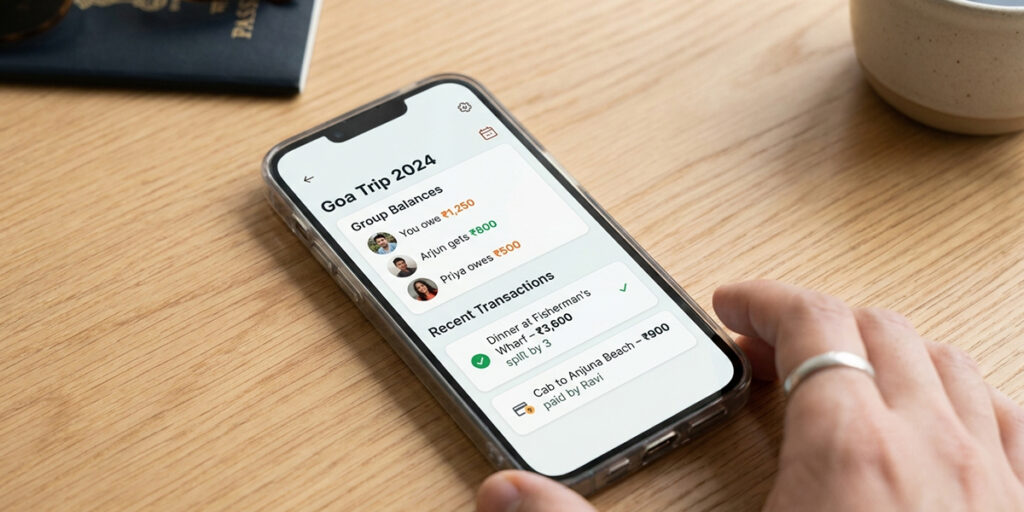
If you’re coordinating a group of 5 or more, a dedicated expense tracker makes this dramatically easier. Tripsil’s expense tracking feature is built directly into the trip — so every payment, from pre-trip booking to last-day lunch, lives in the same place as the itinerary. No separate Splitwise account. No additional app. Everything in one place, from the first expense to the last.
Step 3 — Log Every Expense Immediately — Not Later
The single rule that makes group expense splitting work: log it when it happens. Not tonight. Not when you get back to the hotel. When it happens.
“I’ll remember it” is the most expensive four-word sentence in group travel.
What “Logging in Real Time” Looks Like
Say your group of 6 goes out for dinner. The bill comes to ₹7,200. Rohan pays. Before the group has finished putting their wallets away, Rohan opens Tripsil, taps “Add Expense,” enters ₹7,200, selects “Dinner — Day 3,” and tags all 6 group members as covered. That’s it. 20 seconds.
Tripsil then automatically calculates each person’s share (₹1,200 each), updates the running balance for every member, and everyone can see where they stand the moment it’s logged.
What doesn’t work:
- A shared Google Sheet that one person updates from memory at the end of each day
- Individual screenshot threads (“did you pay me back for the Uber?”)
- A WhatsApp message with a list of numbers that nobody saves
The pattern that works:
- One person pays → logs it immediately → everyone’s balance updates → move on
It takes longer to type the name of the expense in a message than to log it properly. The difference is that the logged version is accurate, shared, and retrievable. The message disappears into a 400-message thread.
Step 4 — Settle Up at the End — Not Mid-Trip
Let balances accumulate throughout the trip and settle everything in one round of transfers at the very end. Settling mid-trip creates friction, interrupts the experience, and often results in inaccurate partial settlements that have to be revisited anyway.
There’s a temptation to tidy up money every day or two — especially if one person is fronting a lot. Resist it.
Mid-trip settlements are messy because the picture isn’t complete yet. The person who has paid a lot so far might have fewer expenses in the second half. The person who has paid almost nothing might pick up the last group dinner and the airport run. Partial settlements made before the trip ends often need correcting later.
One final settlement, after the last expense is logged, is cleaner, faster, and involves fewer transfers.
Sample Final Settlement (Group of 6, 4-Day Trip to Bali)
| Person | Paid | Owes | Balance |
| Priya | ₹18,500 | ₹12,000 | +₹6,500 (gets back) |
| Rahul | ₹6,200 | ₹12,000 | -₹5,800 (pays) |
| Ananya | ₹14,100 | ₹12,000 | +₹2,100 (gets back) |
| Dev | ₹9,800 | ₹12,000 | -₹2,200 (pays) |
| Sara | ₹11,200 | ₹12,000 | -₹800 (pays) |
| Kiran | ₹12,200 | ₹12,000 | +₹200 (gets back) |
Total shared expenses: ₹72,000 · Per person equal share: ₹12,000
Tripsil calculates this automatically and suggests the minimum number of transfers needed to settle everything. Instead of everyone transferring to everyone else, the app figures out the most efficient path — usually 3–4 transfers for a group of 6, not 15.
What About Splitwise? — Why Trip Planning Changes Everything
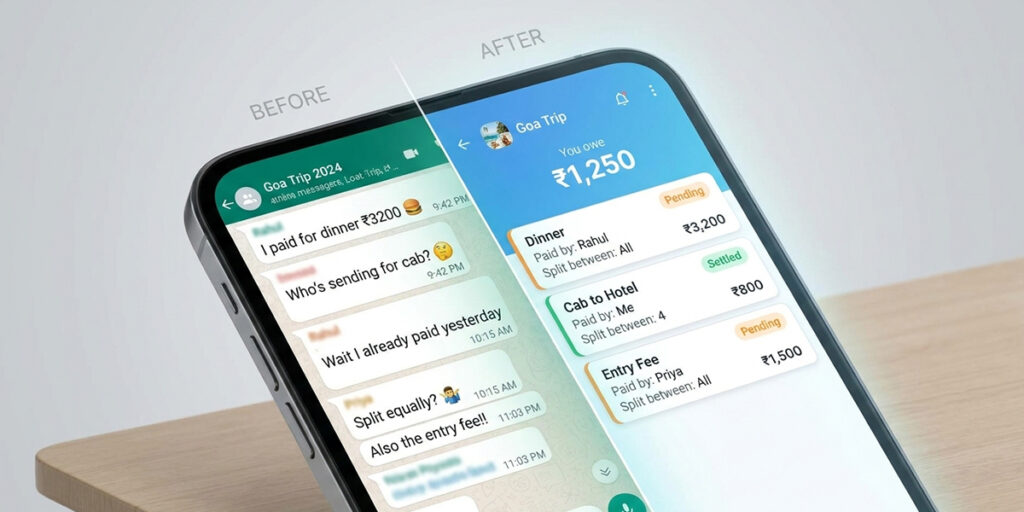
Splitwise is genuinely excellent at what it does. For housemates splitting rent and groceries, for flatmates tracking monthly costs, for any ongoing shared expense situation — Splitwise is one of the best tools available. The interface is clean, the calculation is accurate, and the user base is huge.
But on a group trip, expenses don’t exist in isolation. They’re inseparable from the itinerary.
The ₹4,200 dinner that Priya paid for wasn’t just a dinner — it was the restaurant on Day 3 that was added to the Goa itinerary, which came up in the group chat discussion on Day 2, which three people confirmed they were attending and two said they’d meet later. When that expense is logged in a standalone bill-splitting app, it’s just a number. When it’s logged in Tripsil, it’s connected to the day, the itinerary item, and the group chat thread where it was discussed.
That connection matters — especially when someone disputes a shared cost at the end of the trip. “Wait, I wasn’t there for that dinner” is a statement that takes 20 minutes to resolve in a standalone expense app. In Tripsil, you tap the expense, see the itinerary item it’s linked to, and the group chat message where everyone confirmed. Conversation over.
Splitwise is a powerful standalone tool. Tripsil vs Splitwise for a full comparison. For a group trip where the plan, the communication, and the money are all connected, Tripsil is the integrated solution.
Split Travel Expenses Automatically With Tripsil — Trips Simplified
Group trip money disputes are almost always a data problem, not a trust problem. When everyone is working from the same accurate, real-time information — the same expense log, the same running balances, the same payment history — there’s nothing to dispute. The numbers are the numbers.
Tripsil — Trips Simplified builds expense splitting directly into your trip — not as a separate tool you have to remember to open, but as part of the same app where your itinerary and group chat live. Log an expense in three taps, and everyone’s balance updates instantly. Settle up at the end with the minimum number of transfers. No spreadsheet, no awkward messages, no post-trip silence.
→ Track who paid what — real-time, automatic balance calculation
→ Split costs equally or customise per person — flexible for every trip type
→ Settle up cleanly at the end — minimum transfers, maximum clarity
→ Connected to your itinerary and group chat — no more standalone apps
→ 100% free — no subscription, no paid expense tier
Download Tripsil free and never have another awkward post-trip money conversation:
Tripsil — Trips Simplified. Plan together. Travel together.
Frequently Asked Questions
Q: What is the fairest way to split group trip expenses?
The fairest method is to track every shared expense in real time, split each cost based on who it covered (equal splits for group activities, individual costs excluded), and settle all balances at the end of the trip in one round of transfers. Using a dedicated expense tracker — rather than memory or a spreadsheet — ensures the final numbers are accurate for everyone.
Q: Should the bride pay on a bachelorette trip?
Traditionally, the bride doesn’t pay for her own bachelorette trip — accommodation, activities, and the celebration are typically covered by the group as a gift. However, the exact split depends on the group’s budget and comfort. The clearest approach is to agree on what the bride’s costs are, divide that amount equally among the guests, and track everything in an expense app so nobody feels they paid more than their share.
Q: How do you split accommodation costs unequally?
If group members want different room types or quality levels, split accommodation costs based on actual room usage rather than equal shares. Calculate the cost per room, divide by the number of people in that room, and log each room’s cost separately in your expense tracker. Tripsil allows custom splits so you can allocate accommodation costs accurately, even when the group is in multiple rooms.
Q: What is the best free app for splitting travel expenses?
For standalone expense splitting, Splitwise and Tricount are both solid. For group trips where expenses connect to an itinerary and group communication, Tripsil — Trips Simplified is the better choice. It combines expense tracking, a shared itinerary, and built-in group chat in one free app — so you don’t need three separate tools running simultaneously.
Q: Can you split expenses with someone who doesn’t have the app?
On Tripsil, guests can join a trip and see the shared itinerary without creating an account — they join via a shared link. For expense tracking specifically, group members benefit from having the app installed so they can log costs themselves, but the trip organiser can log expenses on behalf of others if needed. The settlement summary is sharable so everyone sees their final balance regardless.