

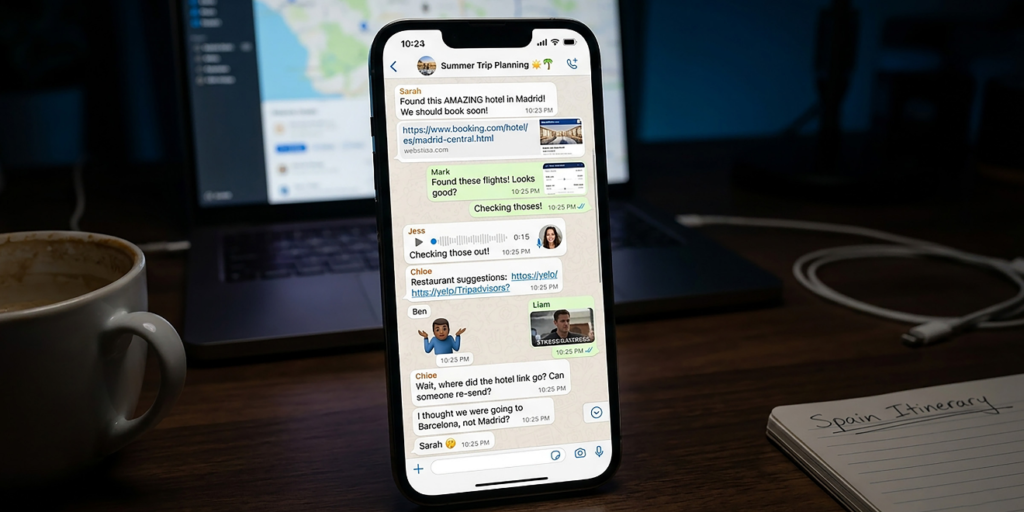
Sound familiar? This is what trip planning looks like for most groups — until it isn’t.
The hotel link was sent on a Tuesday.
By Thursday it was buried under a meme, three “lol”s, a voice note nobody listened to, and a side debate about whether to do a beach or a hill station.
By the following week, someone asked “did we decide on accommodation?” and the person who sent the link — you, probably — had to go back, scroll through 300 messages, find it, and send it again.
This is the quiet nightmare of group chat trip planning. And if you’ve tried to plan any trip with four or more people over WhatsApp, you’ve lived some version of it. The chaos doesn’t happen because your group is bad at communication. It happens because a messaging app was genuinely never built for what you’re asking it to do.
This post breaks down exactly why group chats fail at planning trips — the specific mechanics, not vague complaints — and what actually fixes the problem.
The actual problem with group chats and travel
Before getting into the specific failures, there’s one thing worth understanding clearly: this is not a you problem or a your-group problem. It’s a design problem.
WhatsApp, iMessage, and Telegram are optimised for one thing: keeping a flowing conversation alive. Every design decision they made — new messages at the bottom, no threading, no task assignment, no pinned documents that persist — was made to serve casual back-and-forth chat.
That works brilliantly when you’re deciding where to meet for dinner tonight. It collapses under the weight of a 5-day trip with 7 people, a shared accommodation budget, differing schedules, and a list of things nobody wants to forget.
Think about it this way: the app has no concept of “important.” A hotel booking confirmation and a “haha okay” reply look exactly the same inside a group chat. They both just sit in the scroll, waiting to be buried by whatever comes next.
You’re not using a bad tool badly. You’re using the wrong tool entirely. Here’s what that looks like in practice.
Important information gets buried and stays buried
The mechanic is simple and brutal.
You spend 20 minutes finding a great guesthouse. You share the link with a note: “This one looks perfect, 4.8 stars, fits everyone, ₹2,800 per night.” Two people react with a thumbs up. Three people say nothing. One person sends a TikTok video of a restaurant in a completely different city.
The link is now gone. Not deleted. Just buried. Within 48 hours it’s functionally unreachable unless someone scrolls specifically to find it.
Two weeks later someone asks “did we sort accommodation?” You find the link again. You send it again. Someone says “why didn’t you tell us earlier.” You did. You absolutely did.
The deeper problem is what this does to the person organising the trip. You start spending 30-40 minutes a night just managing a chat thread — re-finding things, re-sharing them, nudging people who haven’t responded, keeping a mental list of what’s been confirmed versus what just got a vague reaction emoji. That’s exhausting for something that’s supposed to be fun.
And the more times you have to resend the same information, the more the group unconsciously treats planning updates as unimportant. The organiser who cried wolf. Except you weren’t crying wolf, you were just using a format that makes everything disappear.
Nobody remembers what they agreed to
“I’ll sort the Airbnb this weekend.”
Twelve thumbs up. Two fire emojis. Everyone moves on.
That was three weeks ago. Nothing has been booked. The person who said it either forgot, assumed someone else took over, or found a reason not to do it and didn’t think to mention it in the chat.
Group chats are full of verbal commitments with absolutely no enforcement mechanism. No task assigned. No deadline visible. No way for anyone in the group to see the status of who is doing what. The commitment lives in the chat for maybe a few hours before it gets buried, and then it simply does not exist anymore.
What happens next is predictable. The person who started the trip planning — usually the most enthusiastic one — quietly absorbs every task themselves. Not because they want full control. Because it’s easier than chasing five different people through a conversation thread for updates on things they may or may not remember agreeing to.
The irony: most groups have people who genuinely want to help and contribute. They just have no visible system that tells them what needs doing, who already has it, and what’s still open. Without that structure, the willing helpers default to assuming someone else is handling it.
Expenses are a disaster waiting to happen
Here is the standard WhatsApp expense process:
Someone pays for something. They post in the chat: “Paid ₹6,300 for the boat, that’s ₹900 each, please transfer.” Three people send it immediately. Two say “sending now” and don’t. One person responds four days later saying they already sent it (they didn’t). The person who paid has no clean record of who has settled. They screenshot the message. They start a manual tally on their notes app. Two weeks in, the tally has errors and they give up.
Multiply this across accommodation deposits, airport transfers, group meals, activity bookings, and day-to-day shared costs. The expense chaos is not a minor inconvenience. It’s a slow erosion of trust between people who actually like each other.
Most people have been on at least one trip where a money thing created an awkward silence that lasted longer than the trip itself. It’s rarely about the actual amount. It’s the ambiguity — not knowing if someone paid, feeling weird about chasing them, sensing they resent being asked again.
Group chats create this ambiguity structurally. There is no running balance. There is no settlement record. There is no way to separate “said they’d pay” from “actually paid.” You’re trying to track shared money inside the same thread where someone is posting a photo of their lunch.
If you want a clear framework for handling group expenses before you even book anything, How to Split Expenses on a Group Trip walks through the exact methods that actually work.
Every small decision becomes a 48-hour thread
“What time should we leave for the airport?”
Eight people. Four different answers. Two people who don’t respond for six hours. One person who changes their answer. One person who asks a tangential question that derails the thread. A sub-debate about whether to take a cab or auto. Someone suggesting an Uber pool which prompts a 12-message argument about luggage space.
Eventually someone just says “8am, final answer” and three people miss that message.
This plays out for every decision. Not just big ones like destination or accommodation, but small ones like which restaurant to try, whether to do the morning hike or the evening one, what time to meet in the lobby. Each of these becomes a multi-hour thread with no clean conclusion.
The psychological toll on the organiser is specific: you’re caught between making unilateral decisions (and being called controlling) or waiting for group consensus (and watching the trip planning drag for months). Neither choice is good. Both choices are the result of using a format that has no mechanism for structured decision-making.
The group chat doesn’t give you a poll. It doesn’t give you a deadline. It doesn’t give you a way to close a question once it’s been answered. You’re doing project management inside a casual conversation tool and wondering why it feels like chaos.
The trip lives across five different conversations
It starts as one group. Then someone makes a sub-chat for “accommodation decisions only.” Then two people are DMing each other about a hotel they found but aren’t sure about sharing with the full group yet. Then there’s a separate thread with the three people who are flying from the same city.
By the time you’ve been planning for a month, trip-relevant information lives in:
- The main group chat
- At least one sub-chat
- Three or four individual DMs
- A screenshot folder on someone’s phone
- A half-finished Google Doc that two people edited once
Nobody has the full picture. You have most of it. Everyone else has fragments.
And then someone drops out of the planning, or just goes quiet, and every conversation they were holding privately takes information with them. The Airbnb host contact they were dealing with. The restaurant they were researching. The local tip they got from a friend.
In a group chat, information lives with the person who sent it. When they’re gone, it’s gone.
For a full framework on how to run group trip planning as a structured process rather than a chat-thread free-for-all, How to Plan a Group Trip Step-by-Step is worth reading before your next attempt.
What purpose-built tools do differently
A group chat is a horizontal stream. Every message lives at the same level, in chronological order, with no structure around it. A purpose-built trip planning tool is a vertical structure organized around a specific event. The difference isn’t cosmetic.
| Feature | WhatsApp / Group Chat | Dedicated Trip App |
| Shared itinerary | No | Yes |
| Expense tracking | No | Yes |
| Task assignment | No | Yes |
| Searchable trip info | Buried in chat | Organised by trip |
| Decision history | Lost in scroll | Logged and visible |
| Photo memories | Scattered across phones | Unified in one place |
| Cost | Free | Free (Tripsil) |
The key shift is this: in a group chat, the trip exists only in the memory and effort of whoever is organising it. In a dedicated tool, the trip itself is the container — and everything lives inside it, visible to everyone, accessible any time.
One of those apps is free and was built specifically for the exact problems above. Not adapted from a general productivity tool. Built from scratch for this.
Why Tripsil specifically fixes this
Tripsil is a free group trip planning app for iOS and Android. The specific reason it’s worth mentioning here — rather than just saying “use a better tool” — is that it was designed around the five failure modes described above, not as an afterthought.
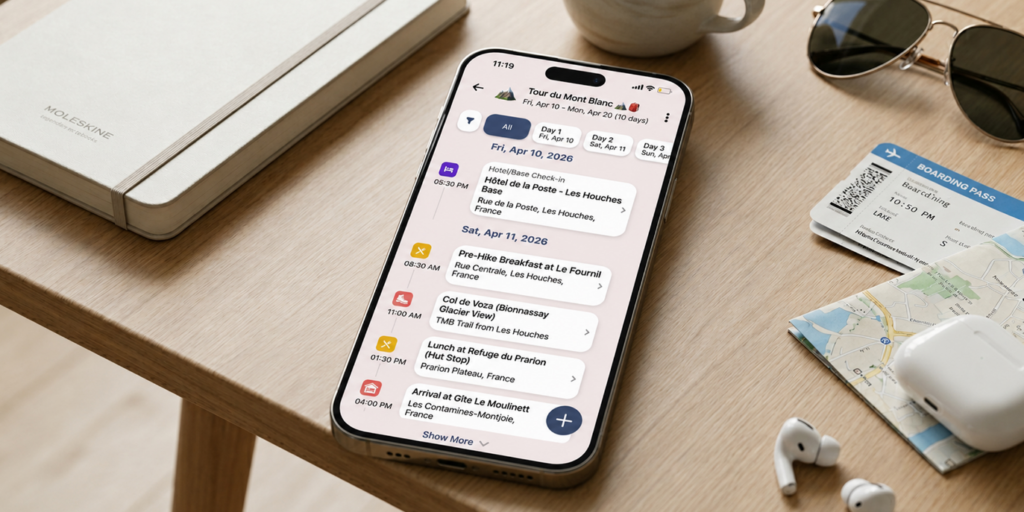
Here’s what that looks like practically:
On buried information: Everything in Tripsil lives in a shared trip timeline. Accommodation link, transport booking, activity confirmation — they’re all there, permanently visible, searchable, not subject to being pushed off screen by someone’s meme.
On zero accountability: Tasks get assigned to specific people with visible status. Everyone can see what’s been done, what’s pending, and who owns it. The organiser stops being the only person holding the full picture in their head.
On expense chaos: There’s a built-in expense splitter that tracks every group payment, calculates each person’s running balance, and handles multi-currency trips. No screenshots. No manual tallies. No “I thought you paid that.”
On decision fatigue: The group chat in Tripsil sits directly next to the itinerary. Decisions happen in context — next to the information they’re actually about — rather than in an undifferentiated scroll where nobody remembers what was already settled.
On fragmentation: One link. One app. Everyone in the group sees the same itinerary, the same expenses, the same task list. There are no sub-chats, no information silos, no orphaned DMs.
It’s free to download, no subscription required, works on iOS and Android. You can see everything includes in tripsil..
Download Tripsil and start planning your trip stress free.
FAQ
Why is WhatsApp bad for planning group trips?
WhatsApp was designed for conversation, not coordination. Important links and decisions get buried under casual chat. There is no way to assign tasks, track expenses, or record what was agreed. Every piece of planning lives only in the chronological scroll, which means it effectively disappears within days of being posted.
What is the best app for group trip planning?
Tripsil is one of the most purpose-built options available. It combines a shared itinerary, expense splitting with running balances, task assignment, and group chat in a single app — free on iOS and Android. The difference from WhatsApp is structural, not superficial: information has a permanent home rather than living in a scroll.
How do you keep track of group trip plans without losing information?
Move everything out of the chat thread and into a dedicated trip space where information is organised by topic, not by time. Apps like Tripsil give bookings, tasks, and decisions a fixed location that every group member can find without scrolling. The goal is a single source of truth the whole group can reference, not a chat history only the organiser knows how to navigate.
How do you split expenses on a group trip?
Log every shared expense as it happens into a tracker that calculates each person’s running balance. Tools like Tripsil and Splitwise automate this. The worst approach — which most groups default to — is posting amounts in WhatsApp and trusting people to send money based on a message they may have already scrolled past. That system produces ambiguity, and ambiguity produces resentment.
What should a group trip planning app include?
At minimum: a shared itinerary all members can view and edit, expense tracking with per-person balances, task assignment with visible owners and status, and an integrated communication space. Anything that makes you rely on a second or third app for core trip information is a friction point that will cost you at some stage of planning.
How do you coordinate a large group trip?
Assign a lead planner before planning begins, not after chaos sets in. Move planning into one shared tool rather than a group chat. Set decision deadlines. Run a short pre-trip video call to align everyone on the itinerary, logistics, and ground rules. The bigger the group, the more structure you need — because more people means more potential for information to fragment and tasks to fall through.
Stop planning in the chat. Start planning in one place.
Group trips don’t have to be stressful. While group chats are great for conversations, they’re not built to manage itineraries, bookings, expenses, and shared plans all in one place. Instead of letting important details get buried in endless messages, organize your trip in singe app. Keep everything in one place, stay aligned with your group, and spend less time coordinating and more time enjoying the journey.
Download Tripsil free on iOS and Android and move your trip somewhere it can actually survive the planning process.