


1. When a Dream Trip Quietly Turns Sour
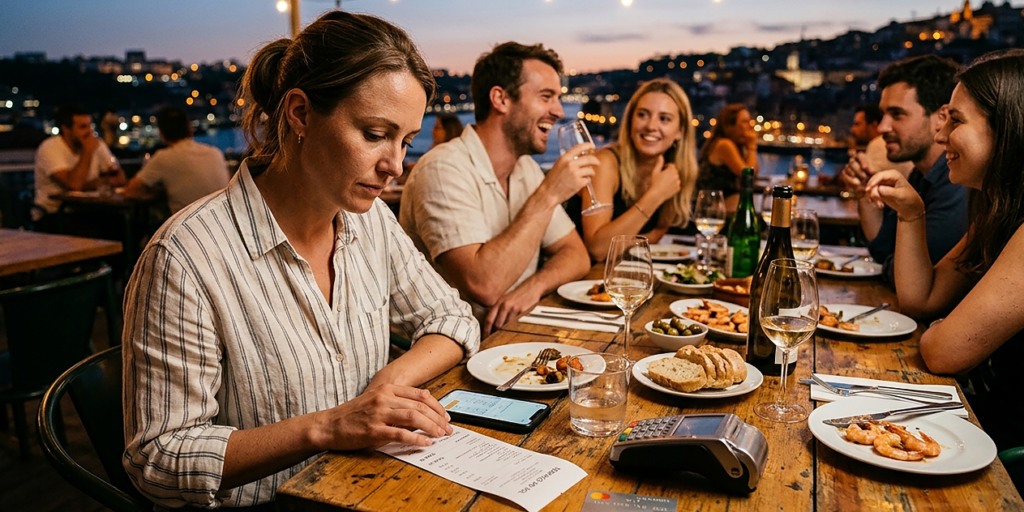
Picture this. It’s day three of a trip your group spent months planning. The group chat — which was full of memes, countdowns, and “I can’t believe we’re actually doing this” energy two weeks ago — has gone oddly quiet.
One person upgraded to a private room without mentioning it to anyone. Someone else ordered the most expensive thing on the menu and suggested the table “just split it.” And at least one person has been doing the mental arithmetic on shared costs since the airport and is now visibly less fun than they were at home.
Nobody’s said anything yet. But the energy has shifted, and everyone can feel it.
Here’s what actually happened: the trip fell apart before anyone even landed. It fell apart in the two months of planning when nobody said out loud what they were actually comfortable spending. The tension at dinner isn’t about the bill. It’s about the fact that five people showed up with five completely different ideas of what this trip was supposed to cost — and nobody checked.
This is not a rare story. It plays out on group trips constantly. And the frustrating part is that it is almost always completely preventable with one honest conversation before the first deposit clears.
2. The Real Reasons Group Travel Budgets Collapse
Before getting into solutions, it is worth naming exactly what goes wrong. Most group travel budget problems don’t happen because someone is selfish or irresponsible. They happen because of three very specific, very fixable failures.
Nobody said their actual number out loud. One person budgeted $1,500 for ten days and thought that was more than enough. Another quietly assumed $2,800 was the floor. Both said yes to the trip, each thinking the other was working from the same figure. Group trip planning starts to fail the moment people agree to go without agreeing on what going actually costs.
There was no spending system, so every expense became a fresh negotiation. Who covers the taxi to the restaurant? Does the person who skipped the boat tour still chip in? Is the wine at dinner shared or individual? Without a framework decided on before the trip, you are relitigating these questions every single day. It drains the energy from a trip faster than almost anything else.
The cost-splitting method was assumed, not agreed upon. An even split of every bill sounds simple and fair on paper. It stops feeling fair when one person ate a salad and drank water and another had steak and two cocktails. “Just pay for yourself” sounds clean until the bill for the shared villa arrives and someone’s card gets declined.
Fix these three things before you book anything and you’ve already handled the hardest part of planning a group trip.
3. How to Set a Group Travel Budget Everyone Can Actually Live With
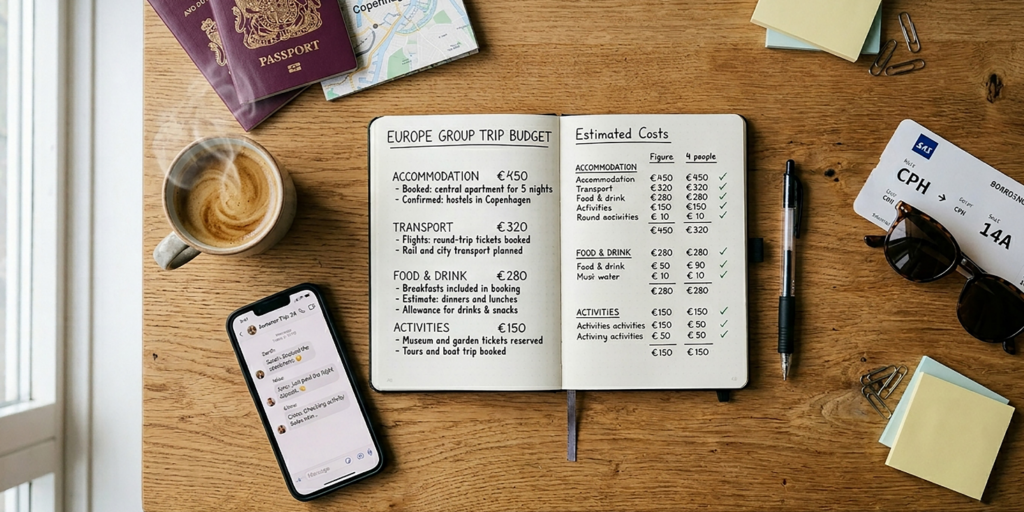
Start with the money conversation — before anyone pays a deposit
This conversation feels awkward. Have it anyway, because nothing that happens during the trip is as uncomfortable as the conversation you’ll be forced to have if you skip it.
The most effective approach is to ask everyone in the group one specific question: what is the total you are comfortable spending on this trip, including flights? Not a daily rate — a total. People think more clearly about totals than they do about daily budgets.
Once you have everyone’s number, look at the actual spread. If the lowest answer is $900 and the highest is $2,800, that is a real gap that needs honest discussion before a single booking is made. It doesn’t mean the trip is off. It means the group needs to figure out what version of the trip works across that range — or whether the range is too wide.
This one conversation does more for your group travel budget than any app or expense tracker ever will.
Budget tiers are better than forcing everyone into the same number
Not everyone in a friend group is at the same financial point in life right now, and that’s completely normal. Trying to force a single budget on a group with genuinely different incomes either leaves someone feeling stretched beyond their comfort zone or another person feeling like they’re on a trip they didn’t actually choose.
A smarter approach is to define tiers for the parts of the trip where spending can reasonably differ, and to be explicit about which parts are shared regardless:
| Tier | Accommodation | Food | Transport | Activities |
| Budget-conscious | Shared dorm or multi-bed rental | Street food and local eateries | Public transit only | Free or very low-cost options |
| Mid-range | Private room in shared rental | Mix of sit-down and casual meals | Occasional rideshare | One or two paid experiences |
| Comfortable | Own hotel room or suite | Mostly sit-down restaurants | Convenience transport | Curated or premium experiences |
The key step is drawing a clear line between what is shared — the rental property, a pre-booked group tour, airport transfers — and what is personal. Once that line exists, people can spend freely within their own comfort zone without anyone feeling judged or quietly subsidised.
Write down the shared costs before anything else
Before you start browsing restaurants or debating day trips, list every expense the whole group will split regardless of what anyone else does: the accommodation booking, the transport to and from the airport, any activities the entire group has already committed to. That is your fixed shared cost pool.
Everything outside that pool is personal. That boundary is what keeps group trip planning from turning into a running negotiation.
If you’re using Tripsil to plan your trip, this is where it genuinely helps. You can map out the full itinerary, mark which shared costs everyone has confirmed, and give the whole group visibility into the plan before anyone has packed a bag. No more “wait, I thought that was included” conversations on day two.
4. The Four Spending Pockets: Where Your Group Travel Budget Actually Goes
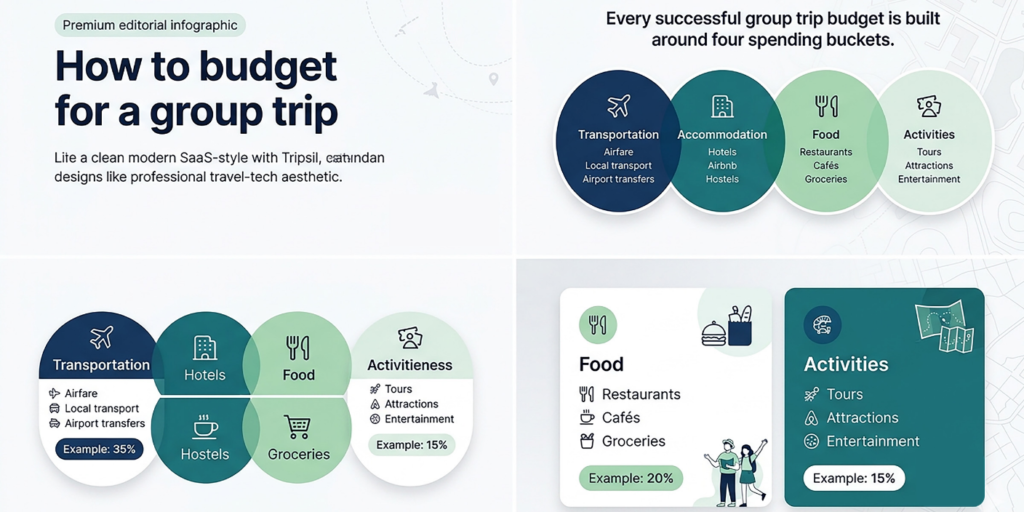
Here is a way of thinking about travel budget planning that changes how most groups approach it: every trip budget, regardless of destination, group size, or length, flows into four spending pockets. Transportation. Accommodation. Food. Activities.
Most groups try to save money evenly across all four. That feels balanced, but it isn’t a strategy — it’s just being equally underfunded everywhere in a way that makes the whole trip feel slightly off.
The smarter move is to decide what this specific trip is actually for and direct your money toward that answer.
Match your budget to what the trip is really about
- If the trip is about being somewhere specific — a national park, a historic city, a coastline — then accommodation and transport deserve the most investment. You don’t need five-star dinners when the reason you came is right outside. Cut food costs through communal cooking and local markets and redirect that money toward the experience of being there.
- If the trip is about food, culture, and neighbourhood life — markets, local restaurants, wandering without a plan — then put real money into meals and give yourself a simpler, cheaper place to sleep. The accommodation is just where you recover between the parts that actually matter.
- If the trip is about doing things together — a ski trip, a music festival, a surf week, a hiking circuit — then activities deserve the budget. Eat simply, stay practically, and spend on the experiences. The memories will be in what you did, not the thread count of the sheets.
A real-number breakdown of how this works
Four people. A 10-day group trip. $1,500 per person, meaning a $6,000 total group travel budget.
| Spending Pocket | If this is NOT the priority | If this IS the priority |
| Flights + local transport | $350 per person | $600 per person |
| Accommodation | $350 per person | $600 per person |
| Food and dining | $200 per person | $350 per person |
| Activities and experiences | $150 per person | $300 per person |
| Buffer and personal spending | $150 per person | $450 per person |
The total per person is still $1,500 either way. What changes is what it actually buys. A beach trip where the group plans to spend most of their time at the shore doesn’t need $300 per person in activities. A city trip built around food tours, museums, and live events absolutely does.
One more lever most groups never use: travel timing
Shifting the same trip from peak summer to shoulder season — April, October, or early November depending on the destination — typically cuts 20 to 40% off flights and accommodation alone. On a $6,000 group budget, that is a meaningful amount of money that can go back into whatever pocket matters most to your group, or simply stay in everyone’s pocket.
5. How to Split Travel Costs Without Ruining the Friendship
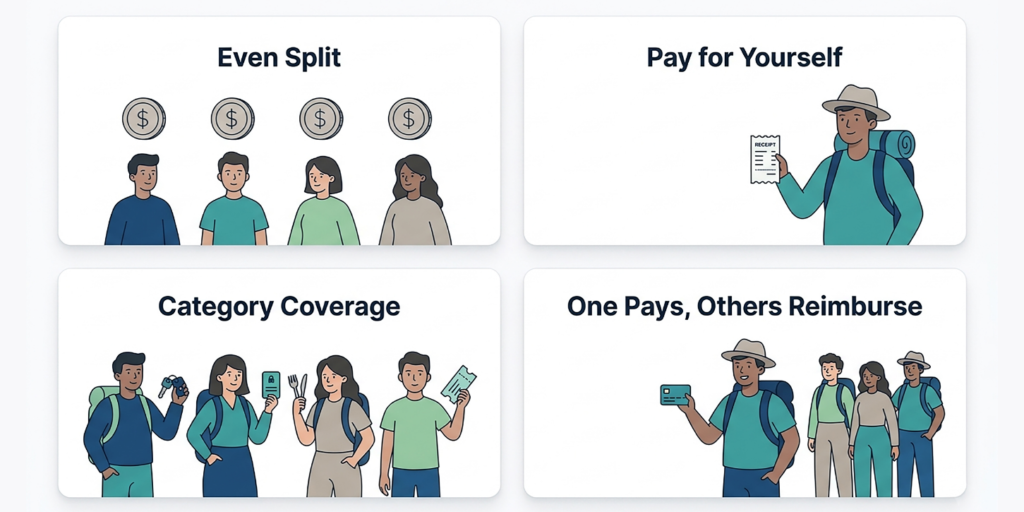
Figuring out how to split travel costs in a group is where a lot of trips go sideways — not because people are unreasonable, but because nobody locked in a method before the first shared expense arrived. There are four approaches that genuinely work. The right one depends entirely on your group.
The four cost-splitting methods, honestly assessed
Even split — divide every group expense equally
Every shared cost gets divided by the number of people in the group, regardless of who consumed what or how much.
When it works well: Groups at similar income levels where everyone participates in most activities and nobody is quietly keeping score on individual consumption. It is simple, it requires no ongoing tracking, and it works smoothly when the group is genuinely aligned on spending.
When it breaks down: Mixed spending habits, someone who consistently eats or drinks more, or a group where one person keeps opting out of activities but is still expected to chip in on group costs.
Pay for yourself — each person covers exactly what they used
Individual costs are personal. Genuinely shared costs — the rental, a group-booked excursion — are split equally. Everything else, you cover your own.
When it works well: Groups with noticeably different budgets or travel styles, where some people want to splurge on certain things and others don’t. It removes the “I shouldn’t have to pay for that” tension entirely.
When it breaks down: Trips with a lot of communal spending — shared meals, group activities, a big shared rental — where the line between “group” and “personal” is blurry and someone ends up doing mental arithmetic all day.
Each person covers a spending category
One person books and fronts all the accommodation. Another handles all shared ground transport. A third covers a specific group event or meal. At the end of the trip, everyone compares what they spent and the people who spent less reimburse those who spent more until it balances out.
When it works well: Smaller, well-organised groups with strong mutual trust, where each person is disciplined about not overspending in their assigned area. It spreads the administrative load instead of concentrating it on one person.
When it breaks down: Larger groups, or situations where someone’s category runs significantly over budget and the reimbursement conversation becomes complicated.
One person pays, everyone reimburses
The most organised person in the group — often the one who planned everything anyway — puts all shared expenses on their card. Everyone else settles up against a running tally, either as they go or in a lump sum at the end.
When it works well: Groups where one person genuinely wants to manage the finances, has the credit buffer to front costs comfortably, and the rest of the group commits to settling promptly and without drama.
When it breaks down: The moment anyone is slow to reimburse. One person carrying the group’s expenses for ten days and then chasing people down afterward is how friendships quietly strain.
The one rule every group skips and then regrets
Decide on your method before the first shared expense happens. Not after someone has already bought dinner for the table and is now emotionally invested in being paid back for the exact amount of guacamole they didn’t eat.
Lock in the splitting method in the same conversation where you agree on the travel budget. It takes five minutes. It prevents a week of accumulated tension.
6. Smart Ways to Stretch Your Group Travel Budget Further
Once you have the budget set and the splitting method agreed on, the question becomes how to make that money go further without the trip feeling like an endurance test in frugality. These approaches actually work.
Rent a house or apartment instead of booking individual hotel rooms
A well-chosen vacation rental for four to six people almost always costs 30 to 50% less per person than equivalent individual hotel rooms. That alone is significant. But the secondary benefit is the shared common space — a living room, a kitchen, outdoor space if you’re lucky — that genuinely changes the feel of the trip. You get somewhere to decompress together that isn’t a hotel lobby.
Cook together a few times instead of eating out every meal
This is not about being cheap. It’s about the math and, honestly, about having one of the better evenings of the trip without realising it until after.
A group dinner cooked in the rental kitchen costs a fraction of what the same meal would cost at a restaurant. More importantly, it frees up real money for one genuinely excellent dining experience rather than five mediocre ones. Buy ingredients at a local market, cook something that doesn’t require a recipe, and sit around a table without a bill landing in the middle of the conversation. It’s almost always a highlight people mention when they talk about the trip later.
Ask directly about group rates — most people never do
For groups of six or more, it is worth asking about group pricing for tours, excursions, boat trips, cooking classes, and some accommodation providers. The worst answer is no. In practice, many operators will offer 10 to 15% off for a confirmed group, especially when you’re flexible on timing. Most travellers never ask because it feels presumptuous. Ask anyway. It costs nothing and it works more often than you’d expect.
Rethink how the group moves around
- A rental car split between four people frequently beats four sets of individual transit passes or repeated rideshare trips, especially in destinations where public transport is limited or slow.
- For city-focused trips, weekly transit passes cost meaningfully less than paying per trip. Buy them on the first morning before you spend anything on individual rides.
- Overnight trains or long-distance overnight buses eliminate an entire night of accommodation cost. On a 10-day trip, that is real money — money that goes directly back into whichever pocket matters most to your group.
Keep the whole plan in one shared space
The hidden cost of group travel isn’t flights or accommodation. It’s the coordination overhead: itinerary decisions buried across 60 message threads, a budget tracked in someone’s personal spreadsheet nobody else can access, confirmation details in four different inboxes, and half the group genuinely unsure what’s been booked and what hasn’t.
Tripsil puts the itinerary, the shared costs, and the group’s decisions in one place that everyone can see and contribute to. Less time spent coordinating, less confusion on the ground, more of the trip spent actually enjoying the trip.
7. Two Things You Should Never Cut From Your Group Travel Budget
Knowing where to save money is valuable. Knowing where not to is more important. Two things are genuinely not worth cutting, regardless of how tight the group travel budget feels.
Travel insurance — every time, for everyone
A missed connection, a medical situation abroad, a bag that gets lost or stolen — any of these are statistically unlikely on any one trip and nearly inevitable if your group travels together regularly over the years. The cost of basic travel insurance is small relative to the overall trip cost. The cost of not having it when something goes wrong is not small. This is not the line item to remove when you’re trying to trim the group budget. Buy it for every person on every trip.
The one experience each person actually came for
If someone in the group has wanted to visit a specific place, do a specific activity, or eat at a specific restaurant for years, that is not where you cut $80 from the group travel budget. Travel budget planning done well isn’t about spending as little as possible — it’s about spending intentionally on what genuinely matters and cutting freely on everything that doesn’t.
Put the money where the meaning is. That’s the difference between a trip that comes up in conversations five years from now and one that everyone has mostly forgotten by the following month.
8. Ready to Plan a Group Trip That Actually Comes Together?
A group trip planned properly is one of the best ways to spend money. A group trip that unravels because nobody wanted to have an honest budget conversation before leaving is genuinely unpleasant — and it was avoidable from the start.
The framework is not complicated. Have the money conversation before you book anything. Agree on a splitting method before the first shared expense. Use the four spending pockets to direct your money toward what your group actually came to do. And don’t cut the things that matter.
If you’re done managing group travel planning across endless chat threads and spreadsheets only one person updates, Tripsil is built for this. Plan the itinerary together, keep the shared budget visible to everyone, and show up on day one with a group that is looking at the same plan.